
Brazing Properties of Novel Fe-based Amorphous Brazing Foils for Joining Steel
Authors: Prof. Dr.-Ing. Kirsten Bobzin, M. Sc. Marvin Erck, Dr.-Ing. Sophie Vinke, B. Sc. Yiğit Baran Aydın
DOI: https://doi.org/10.53192/WAC202602104
Alloy systems in the field of brazing must meet ever-increasing requirements in terms of mechanical properties. Cost
efficiency and environmental compatibility must always be considered. To limit time-consuming alloy design, the use of
thermodynamic simulation is becoming increasingly important in scientific research. Using a thermodynamic database,
the authors recently developed two novel Fe-based brazing foils. These foils are used for brazing X6CrNiMoTi17-12-2 in
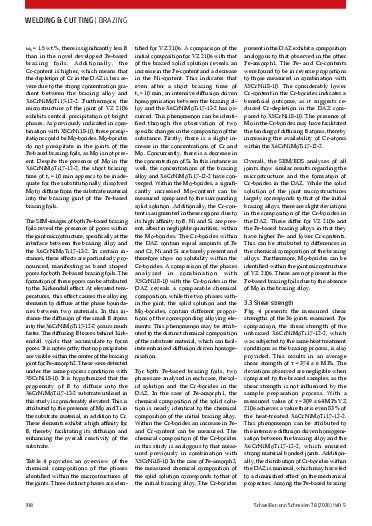
a vacuum furnace at T = 1,200 °C for t = 10 min. Investigations of the joints are performed using ultrasonic c scan, SEM
(scanning electron microscopy) / EDS (energy dispersive spectroscopy) and shear testing. For comparison, all investigations
are carried out in parallel with an industrial Fe-containing foil. The novel Fe-based brazing foils can be used to produce
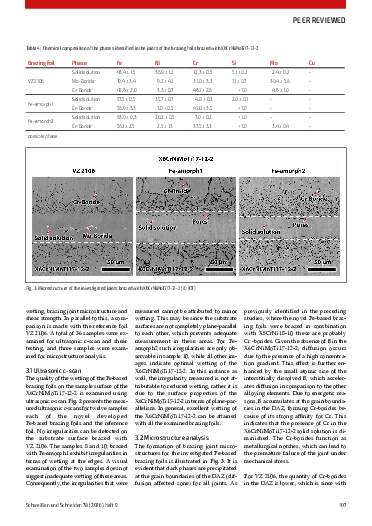
material-bonded joints with excellent wetting on the X6CrNiMoTi17-12-2. SEM images show that strong B diffusion has taken
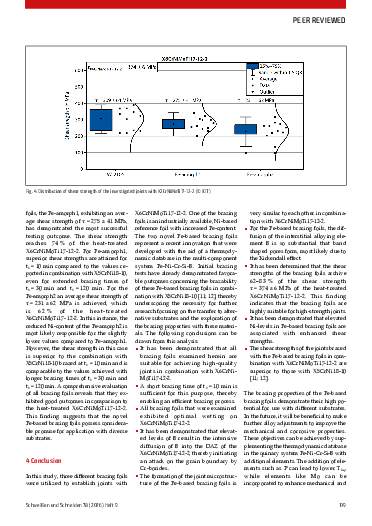
place towards the grain boundaries in the diffusion affected zone of the X6CrNiMoTi17-12-2. The shear strength is good
and exceeds τ > 200 MPa for both Fe-based brazing foils. Investigations have shown that efficient alloy design is possible
with the aid of thermodynamic simulation. This saves time-consuming trial-and-error testing and can be expanded in the
future by adding further elements.

An active subscription enables you to download articles or entire issues as PDF-files. If you already are a subscriber, please login. More information about the subscription