Geometric and Dynamic Factors that Govern Torch Control in Orbital TIG Welding
Author: Joey Colby Bernert
DOI: https://doi.org/10.53192/WAC202602111
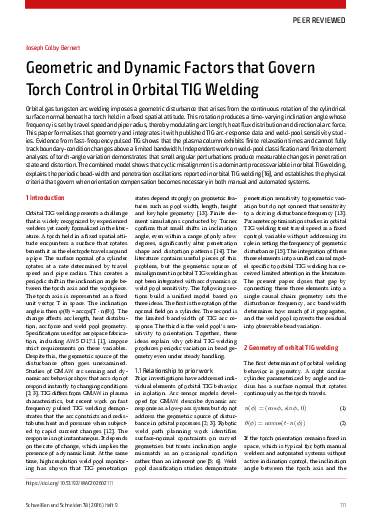
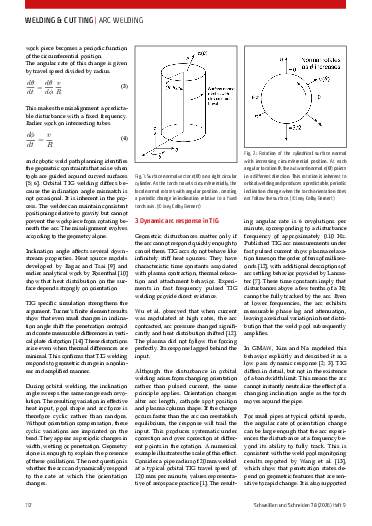
Orbital gas tungsten arc welding imposes a geometric disturbance that arises from the continuous rotation of the cylindrical
surface normal beneath a torch held in a fixed spatial attitude. This rotation produces a time-varying inclination angle whose
frequency is set by travel speed and pipe radius, thereby modulating arc length, heat flux distribution and directional arc force.
This paper formalises that geometry and integrates it with published TIG arc-response data and weld-pool sensitivity stud-
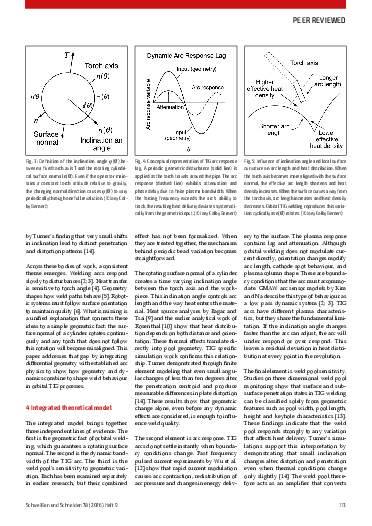
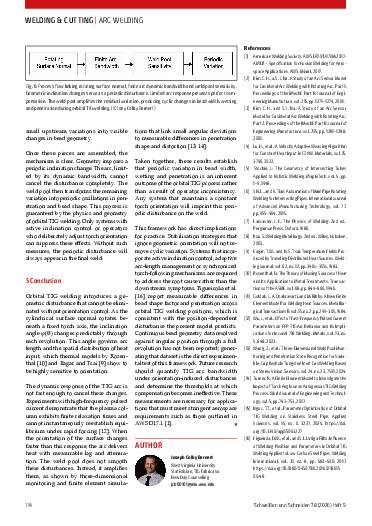
ies. Evidence from fast-frequency pulsed TIG shows that the plasma column exhibits finite relaxation times and cannot fully
track boundary-condition changes above a limited bandwidth. Independent work on weld-pool classification and finite element
analyses of torch-angle variation demonstrates that small angular perturbations produce measurable changes in penetration
state and distortion. The combined model shows that cyclic misalignment is a dominant process variable in orbital TIG welding,
explains the periodic bead-width and penetration oscillations reported in orbital TIG welding [16], and establishes the physical
criteria that govern when orientation compensation becomes necessary in both manual and automated systems.

An active subscription enables you to download articles or entire issues as PDF-files. If you already are a subscriber, please login. More information about the subscription